









출고예상일 안내
주문하신 상품이 한국에서 현지 배송을 위한 출고단계가 이루어질 것으로 예상되는 날짜입니다. 상품을 준비하는 과정에서 내부적인 사정으로 인해 출고예상일에 다소 오차가 생길 수 있습니다.
여러 상품(예약상품포함)을 함께 주문하신 경우 출고예상일이 가장 늦은 날짜에 맞춰 함께 배송됩니다.


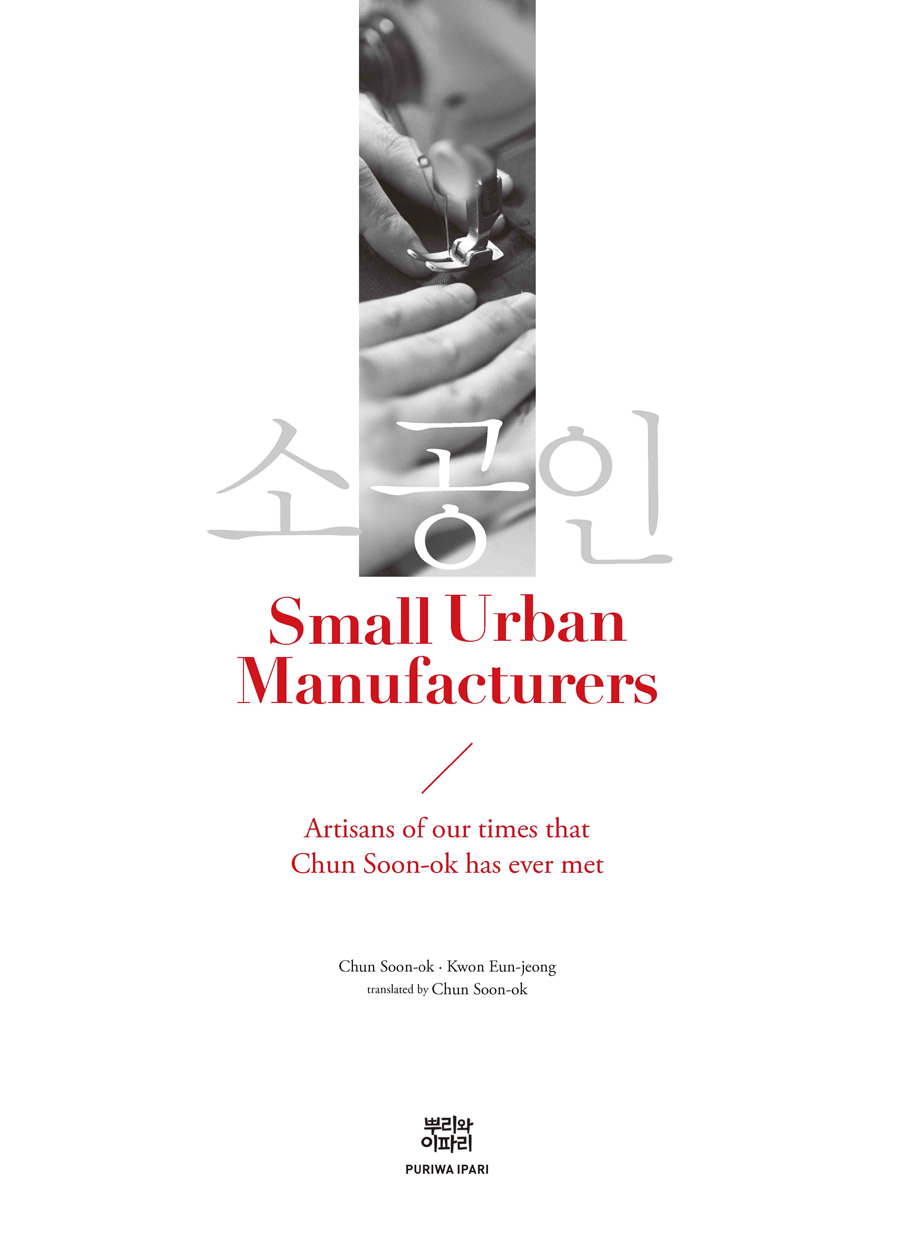





ISBN : 9788964620663 / 316쪽 / 411g / 210 x 150 (㎜)
이 상품에 궁금하신점이 있으세요? 1:1상담문의



아래의 도서와 구매하시면 이 도서들의 적립금을 즉시적용해 드립니다.
-

김수영
-

이종대왕 이종혁
-
이세환
-
제러미 리프킨
- 17,100
- 16,200
- 21,150
- 20,700


출판사 리뷰
1. About this book Who says manufacturing is a sunset industry? The sewing machine is still running Young assistant sewing machine operators who were working in the dust in sewing factories around Pyeonghwa Market in the 1970s have now entered middle age, but their sewing machines are still running in alleys around Changshin-dong or Seongsu-dong. Although they have had to endure harsh labor conditions throughout Korea’s industrialization process from the 1970s to 1980s while playing a part in the “Miracle on the Han River”, they have never received attention from society, nor have they benefited from government policies. While most consider small manufacturing a dying industry, small manufacturers of clothing, handmade shoes, bags, glasses, jewelry and other accessories, and those engaged in printing services and metal processing have continued to grow in small steps. As a result, the number of small manufacturers today is about 300,000 across the country, with as many as 910,000 employees. The work done by those small manufacturers employing no more than 10 workers is labor intensive and relies on highly-specialized skill sets, including fine manual skills. These businesses also tend to gather in certain areas. Chun Soon-ok, the author of this book, has dubbed them “small urban manufacturers”. For a long time, they have been collectively referred to as “microenterprises” together with small merchants. Now, however, they have finally received their own designation, small urban manufacturers, and have a distinct identity. Why small manufacturers? So far, government policies of support for microenterprises have focused only on small merchants. Policies of the current administration to achieve an employment-to-population ratio of 70 percent also focuses mainly on services and new growth industries of the future only. To be sure, it is important to identify and nurture new growth engines. However, if we have existing industries that can compete on global markets with a small amount of effort to nurture and develop them, there is no reason to ignore those existing industries. While everyone pays attention only to the latest technologies and service industries, small manufacturers have supported the economy from the bottom up for the past several decades, relying only on their manual skills. They have silently turned small manufacturing into an industry with KRW 74 trillion in sales and KRW 10 trillion in operating profits. Moreover, small manufacturers exert great influence on the competitiveness of the entire industrial economy as well as that of local industries, since business-to-business industrial suppliers tend to gather around them, given the nature of such manufacturers. Although they account for a small percentage of total industry sales, small manufacturers at the bottom of the supply chain as subcontractors or the like affect markets that amount to a whopping KRW 395 trillion. Furthermore, small manufacturing is a high skill- and technology-intensive industry, meaning it has a significant impact on the creation and retention of employment opportunities. In essence, small manufacturing is a promising solution to unemployment of ordinary citizens. Indeed, whereas a large number of small merchants close down their businesses within 3 years of starting, small manufacturers continue operating for at least a decade and sometimes over four decades. This means that, although they also have to weather economic downturns, small manufacturers are capable of earning money and have prospects for the future. The author also worked as an assistant sewing machine operator at sewing factories when she was young. Then, after studying abroad, she ran a sewing academy and social enterprises for over a decade. From this experience, she has developed a deep understanding of the difficulties facing small manufacturers and the industrial values they have, and has made it her primary duty to shine the limelight on them. Now, common practical problems faced by these manufacturers in their practice include a lack of new workers entering the industry due to the poor working environments, a highly-skilled workforce that is aging, and the destitute financial situation of many manufacturers. Considering that small manufacturers have remained largely neglected in national policies for a long time, the author felt the need for comprehensive measures for support rather than band-aid solutions. As a result of over two years of research and other efforts, she introduced the Special Act on Assistance to Small Urban Manufacturers, which came into force on May 29, 2015. This legislation is a meaningful outcome that stems from her belief that \"Labor is the solution, and the solution is in the field.” Look at these people The author interviewed representative artisans in a variety of fields including clothing, handmade shoes, bags, jewelry and other accessories and has made those interviews into a book to convey the value of life as a craftsperson to many people, especially the youth. The interviewees are nine artisans she met over the 11 years she worked around Changshin-dong once she had returned to Korea after studying abroad as well as over the 4 years she was a lawmaker. During those years, she discovered their real value. One of the interviewees, an artisan bag maker, says that he has realized that, after pursuing a single vocation for over four decades, only a happy person can make a beautiful product. Another interviewee, a sewing artisan, reveals that, although being called a factory girl when she was young was hurtful, now she can say with pride that sewing is the most valuable work in the world. An artisan shoemaker states that, after doing it for five decades, his work is the most valuable thing in his life that he would not exchange even for a diploma from the most prestigious university in Korea. A clothes pattern technician in his 60s who earns a six-figure salary after working for a designer brand emphasizes that, as long as technicians are looked down on, the fashion industry has no future. Two artisans who craft jewelry and other accessories let out a deep sigh, saying that the country has the best skills in the world, but it is losing market share to other countries due to lack of policy support. Although they work in different areas, the nine artisans have one thing in common: a strong sense of pride in their skills and a willingness to teach those skills to people eager to learn. Most started working in their respective areas as teenagers, and have operated sewing machines or tanned leather for three to five decades. They became artisans from ordinary technicians, relying only on their manual skills. Although their work has not taken them into the limelight of the society, they have proven with their whole lives that, although there is no such thing anymore as life-long employment, there is life-long occupation. The problem is that it will not be long before artisans such as these disappear. It is therefore urgent to create a sustainable working environment for them, together with an environment where they can pass on their skills and hands-on experience to the next generation. Skills never betray you Korea's total unemployment rate is 4.0 percent, but its unemployment rate among the youth (i.e. those aged 15 to 29) was 10.7 percent as of March 2015 according to Statistics Korea. The quality of jobs has deteriorated as well, and one out of five young persons who take their first step in society work under short-term contracts, usually less than a year. Jang Geu-rae, the protagonist of the TV Series \"Misaeng\", has stated that status is not the important thing, namely whether he has regular or contract employment, but that he just wants to keep working. At the Symposium for Future Small Urban Manufacturers, a transcript of which appears as the epilogue to this book, a 30-year old man says, \"Under the circumstances, even if I choose an office job, it would not be an easy feat. Taking all these things into account, I thought it would be better to choose this path. I like this sort of work. It takes a super long time to develop the advanced skills, and one day I might regret taking this career path, but I think it’s better to start now.\" Ms. Chun believes that blue-collar jobs are a permanent \"blue ocean\". She emphasizes that small manufacturing is not a sunset industry but a growth engine for the future. Even now, 910,000 persons working for small manufacturers are supporting the tight-knit manufacturing ecosystem, working in nooks and crannies of urban alleys. She insists that we must help small manufacturing evolve into a noble profession and workers there into key players of a promising industry. The author's strong desire is that, through this book, many youth find their future in small manufacturing before the precious artisanal skills become extinct. 지은이 소개(Authors) Chun Soon-ok Turning 16 in 1970 when her older brother, Chun Tae-il, made the final sacrifice, she had worked at a sweatshop for seven years. She then spent most of her young adulthood participating in labor movements with her mother, Yi So-sun. In 1989, in an attempt to build international solidarity in labor movements, she traveled to the United Kingdom and received a Bachelor’s degree in European Comparative Labor Studies from Ruskin College and Master’s and Ph.D. in Industrial Sociology from the University of Warwick. Her doctoral dissertation, “They are not machines”, won the best dissertation prize at the University of Warwick in 2001, and was then published in the UK and the US simultaneously. In 2005, it was also nominated as an honorable mention for the Industrial Sociology category by the American Sociological Association. Returning home to Korea after 12 years of living abroad, she assumed a university profession position at SungKongHoe University, which lasted for only a year before going back to Dongdaemun, the capital of textile and apparel industry. In the next ten years, she established and managed new social enterprises including daycare and self-study centers for women working long hours, as well as Suda Gongbang, a vocational training center. In May 2012, she held the first proportional representative seat of the Minjoo Party of Korea(what was then known as the Democratic United Party) in the nineteenth National Assembly and sponsored the ‘Special Act on Support for Small Urban Manufacturers’ as a member of the Trade, Industry and Energy Committee. Thanks to that legislation, she won the best legislation of the year award at MoneyToday. Kwon Eun-jeong Writer, translator, and a professional interviewer.

-
- 저자 : 편집부

Preface Finding fresh hope in small urban manufacturers
Prologue The solution in the field
Chapter 1 Crafts never betray you
“As my breath and the movements of the sewing machine become one,
I feel completely at peace.”
_ Kim Do-yeong (Expert Seamstress, 43 years of work)
I Would Not Trade This Honest Work of Shoemaking for a Harvard Degree
_ Yu Hong-shik (Master Shoemaker, 55 years of work)
Happy Craftspeople Make Masterpieces
_ Kim Jong-eun (Master Bag Maker, 42 years of work)
Thoughts for the Future of Craftspeople 1
It Takes Both Craftspeople’s Own Efforts and Government Support to Create a Brighter Future for Korea’s Dressmaking Industry _ Park Gyeong-mo (Chairman, Seoul Apparel and Dressmaking Cooperative
Chapter 2 Can we just get a word?
There Will Be No Future for the Korean Fashion Industry without Craftspeople
Being Properly Treated First
_ Jang Hyo-ung (Master Patternmaker, 43 years of work)
I Could Make Shoes Even with Fallen Leaves
If People Were to Recognize the True Value of My Work
_ Yang Yeong-su (Master Shoemaker, 37 years of work)
Current Status of Traditional Jewelry Craft in Korea: Excellent Jewelry Makers, Poor Distribution Support
_ Kim Sang-sil (Master Jewelry Craftsman, 25 years of work)
Thoughts for the Future of Craftspeople 2
Resuscitating Dongdaemun with a New R&D Cluster _ Cho Dong-seong (Professor, College of Management, Seoul National University)
Thoughts for the Future of Craftspeople 3
Three Steps toward Making Dongdaemun a Central Hub for Fashion Industries in Asia _ Park Hun (Researcher, Korea Institute for Industrial Economics and Trade)
Chapter 3 Crafts contained the breath of their makers will be forever
By Teaching Aspiring Dressmakers, I Realized That
I Was the Only One Who Refused to See the True Value of My Work
_ Han Sang-min (“Total” Dressmaker, 38 years of work)
Learning the Lessons of Tailored Suits from a Silver-Haired Master
_ Kim Eui-gon (Master Tailor, 57 years of work)
Reclaiming Korea’s Position as a Leading Global Center
for Jewelry Production
_ Kim Jong-mok (Master Jewelry Maker, 43 years of work)
Wholehearted Dressmaking
_ Ji Su-hee (Master Dressmaker of Natural Materials, 39 years of work)
Thoughts for the Future of Craftspeople 4
I, Too, Would Like to Present “Made in Korea” Proudly to the World _ Koh Mi-hwa (CEO, J Fashion)
Epilogue Symposium for future small urban manufacturers
“I chose this way because I want to work as long as
I wish to, drawing on my own skills.”
Appendix The full text of the ‘Special Act on Support for Small Urban Manufacturers’

