









출고예상일 안내
주문하신 상품이 한국에서 현지 배송을 위한 출고단계가 이루어질 것으로 예상되는 날짜입니다. 상품을 준비하는 과정에서 내부적인 사정으로 인해 출고예상일에 다소 오차가 생길 수 있습니다.
여러 상품(예약상품포함)을 함께 주문하신 경우 출고예상일이 가장 늦은 날짜에 맞춰 함께 배송됩니다.


2021 Consumer Trend Insights (트렌드 코리아 영문판) Ten Keywords regarding What Consumers Want in 2021, the year of the ox
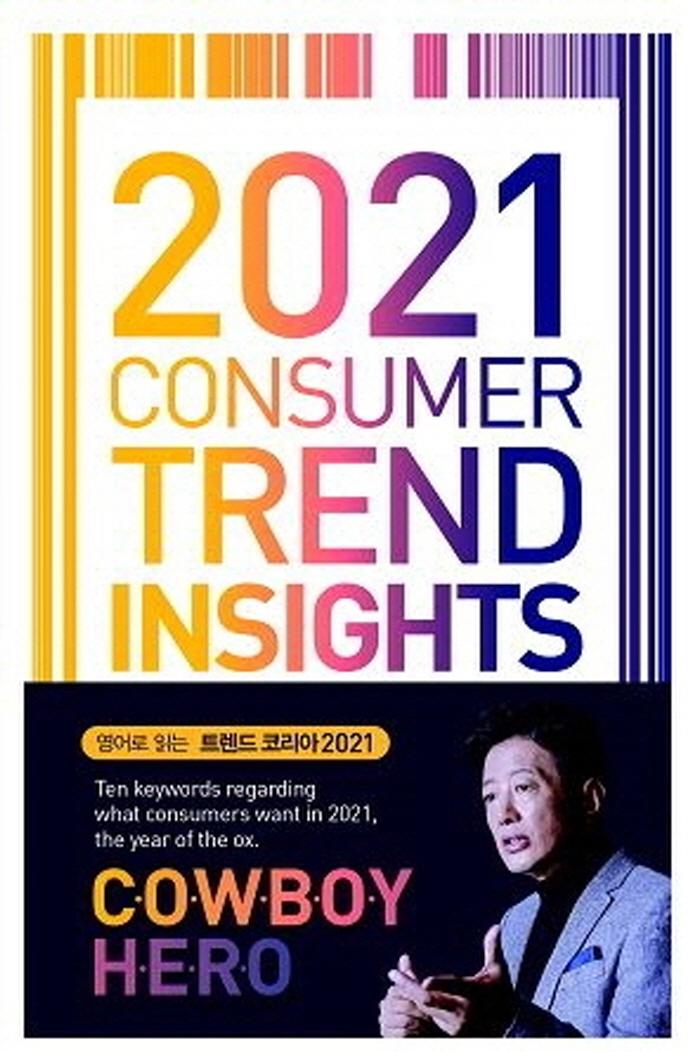





ISBN : 9788959896905 / 280쪽 152 x 223 (㎜)
이 상품에 궁금하신점이 있으세요? 1:1상담문의



아래의 도서와 구매하시면 이 도서들의 적립금을 즉시적용해 드립니다.
-
터보832
-

정구태, 박혜진, 김가영, 이동기, 김호균, 길진세
-
로또맘
-
최영우, 김은경, 김지형, 박선영, 안중수, 윤경록, 이경무, 이공희, 이원석, 한상권, 한용현
- 19,800
- 17,100
- 17,100
- 20,700


출판사 리뷰
본문 보기 As a trend analyst, the question I received most often was: “How will COVID-19 change trends?” And our anal\-ysis of changes in 2020’s global consumer trends, based on our 12 years of research, has led us to the following concluion: “Coronavirus will not change the direction of trends, but it will impact their speed.” In other words, the pandemic has quickened the pace of polarization, intensifying trends that were on the rise, and diminishing keywords that were waning. Just take a look at online and mobile purchases, teleworking, and home-schooling, which are now mainstream ― a drastic change from pre-COVID days when they were being introduced. What would have previously taken three to four years to implement has taken less than six months. The moral of this crisis is that we need to swiftly respond to changing trends. Once we move forward, we can’t go back. Our best and only option is to closely examine today’s trends and to make meticulous adjustments in response. - Preface How will COVID-19 change the consumer market in 2021? At the time of writing this book, trends remain in drastic flux, and yet we still need to assess a course for the future by analyzing all angles of changes seen so far. In that respect, we propose “V-nomics” as the first trending keyword. The ‘V’ is for “virus,” with “V-nomics” signifying “an economy transformed by the virus.” More importantly, it is the basis for answers to the questions we are most anxious about. The questions are as follows: (1) Can we see an economic rebound, such as a V-shaped recovery? (2) What kind of variations can we expect within the “untact” (a term coined and popularized by the Trend Korea Company, meaning “non-contact”) trend, accelerated by the coronavirus? (3) How will consumer values change? (4) What vision do we need to persevere in this era of V-nomics? - 17P People who have previously emphasized the economic value of homes are now realizing a need to re-examine its significance and changes to its functionality stemming from spiritual and philosophical values. The Layered Home is the trend of perceiving the living space as an area to create one’s lifestyle that also reflects the inhabitant’s future-oriented attitude towards life. The trend of the Layered Home also implies that members of the household need to readjust their relationships with one another. Rather than an unchanging layout that divides space into the main bedroom, children’s room and living room, the home needs to become more flexible to ensure both personal and communal hours, to allow for personal and individual tastes to be expressed as well as for shared family time. - 66P Investment has become a hot topic in recent years at gatherings for those in their 20s and 30s, regardless of gender or profession. Young people, whose major interests used to be movies or TV programs, are more readily chatting about investment opportunities. It is no longer rare to see couples attending lectures on real estate investment and going to a property’s open house while on a date. Among university students, investment study clubs, real estate research, value investments, and proptech (property technology) are all the rage. A middle school student wrote on an online investment community board that while his peers play mobile and computer games, he would rather buy stocks in a game company, such as Netmarble or Nexon. And as the military permitted the use of smartphones on bases, a new tribe of individual investors (referred to as “ants” in Korea) has emerged, calling themselves “soldier ants.” - 82P The crux of a meme lies in willing participation, intense fun, and a short lifespan. Meme creators voluntarily reproduce content and derive satisfaction from the process. Dead content comes back to life in their hands and is born anew and spread in this “perfect consumer-centered new market.” There are three stages to the RC Life. The first is “The Queue.” Waiting to take part in the latest fad is similar to people waiting in line for a roller coaster ride. The second stage is “The Ride.” The erratic up-and-down and round-and-round movements of the journey are electrifying and exhilarating. The ride is similar to that of Gen Z consumer patterns in that they seek new and unpredictable diversions. The last stage is “The Departure.” Once the ride is over, you may feel a tinge of regret, but only briefly; then you disembark and move on to the next ride. The cycle for today’s trends is brief, and once over, another takes hold. - 129P Today’s market for secondhand products is estimated at 20 trillion won ($17.5 billion). It has become even hotter than the primary market which deals in new merchandise. According to a report on the “Analysis of the Secondhand Goods App Market” by Mobile Index, a mobile data analysis platform, daily users of the secondhand trading app Daangn당근마켓 reached 1.56 million, second only to the nation’s favorite shopping app, Coupang쿠팡 with 3.97 million. Daangn not only beat giant online shopping malls such as 11Street, Gmarket, WeMakePrice and TMON, but it was also the only secondhand trading app among the top five shopping apps in Korea. This frenzy over trading in pre-owned goods is slowly spreading beyond Gen MZ. - 174P “I wired the money. Is shipping included?” “Excuse me, but are you RM from BTS? The name and address seem right […]” “Thank you.” This is part of a text message exchange that spread like fire through the online community. A reseller shared screen\-shots from his phone after he sold a pair of secondhand trousers. What caught people’s attention was that the leader of the world’s most famous boyband BTS not only traded in used products, but that he also cares about shipping costs. And he is not alone. Online communities often cite stories about celebrities who have taken to trading in secondhand goods. -175P “Gucci Boy,” “Human Chanel,” “Human Dior,” … When you enter the search word “human인간” followed by a luxury brand such as Gucci or Chanel, images of celebrities decked in the designer apparel flood the screen. Girl group sensation Blackpink’s Jennie is called “Chanel in Human Form,” and actress and singer Bae Suzy is known as the “Human Dior.” BTS’s V, Kai of idol group Exo, singer IU and rapper BewhY are all known as a “Gucci Boy or Girl.” So, if I were a luxury brand, which one would best express me? In fact, the brand itself is a metaphor. Choosing a brand is a process of trying to discover one’s identity. Andy, Anne Hathaway’s character from The Devil Wears Prada, and her transformation throughout the movie are a prime example. Despite her initial aversion to luxury brands, she enters the world of high fashion and goes through an identity crisis, ultimately coming to accept the reality of luxury consumerism and undergo a transformation. It shows how brands in today’s consumer-driven society become a way to express oneself, beyond any preconceptions of their extravagance or ostentation. - 237P

-

- 구분 : 저서
- 이름 : 김난도 (1963)
- 국적 : 대한민국
- 직업 : 교수,컬럼니스트
- 분류 : 문학가 , 경제/경영/자기계발 저자 , 기타
- 인기지수 [68,037] 반디추천[2회선정]
-



As a trend analyst, the question I received most often was: “How will COVID-19 change trends?” And our anal\-ysis of changes in 2020’s global consumer trends, based on our 12 years of research, has led us to the following concluion:
“Coronavirus will not change the direction of trends, but it will impact their speed.”
In other words, the pandemic has quickened the pace of polarization, intensifying trends that were on the rise, and diminishing keywords that were waning. Just take a look at online and mobile purchases, teleworking, and home-schooling, which are now mainstream — a drastic change from pre-COVID days when they were being introduced. What would have previously taken three to four years to implement has taken less than six months. The moral of this crisis is that we need to swiftly respond to changing trends. Once we move forward, we can’t go back. Our best and only option is to closely examine today’s trends and to make meticulous adjustments in response. - Preface
How will COVID-19 change the consumer market in 2021? At the time of writing this book, trends remain in drastic flux, and yet we still need to assess a course for the future by analyzing all angles of changes seen so far. In that respect, we propose “V-nomics” as the first trending keyword. The ‘V’ is for “virus,” with “V-nomics” signifying “an economy transformed by the virus.” More importantly, it is the basis for answers to the questions we are most anxious about. The questions are as follows:
(1) Can we see an economic rebound, such as a V-shaped
recovery? (2) What kind of variations can we expect within the “untact” (a term coined and popularized by the Trend Korea Company, meaning “non-contact”) trend, accelerated by the coronavirus? (3) How will consumer values change? (4) What vision do we need to persevere in this era of V-nomics? - 17P
People who have previously emphasized the economic value of homes are now realizing a need to re-examine its significance and changes to its functionality stemming from spiritual and philosophical values. The Layered Home is the trend of perceiving the living space as an area to create one’s lifestyle that also reflects the inhabitant’s future-oriented attitude towards life. The trend of the Layered Home also implies that members of the household need to readjust their relationships with one another. Rather than an unchanging layout that divides space into the main bedroom, children’s room and living room, the home needs to become more flexible to ensure both personal and communal hours, to allow for personal and individual tastes to be expressed as well as for shared family time. - 66P
Investment has become a hot topic in recent years at gatherings for those in their 20s and 30s, regardless of gender or profession. Young people, whose major interests used to be movies or TV programs, are more readily chatting about investment opportunities. It is no longer rare to see couples attending lectures on real estate investment and going to a property’s open house while on a date.
Among university students, investment study clubs, real estate research, value investments, and proptech (property technology) are all the rage. A middle school student wrote on an online investment community board that while his peers play mobile and computer games, he would rather buy stocks in a game company, such as Netmarble or Nexon. And as the military permitted the use of smartphones on bases, a new tribe of individual investors (referred to as “ants” in Korea) has emerged, calling themselves “soldier ants.” - 82P
The crux of a meme lies in willing participation, intense fun, and a short lifespan. Meme creators voluntarily reproduce content and derive satisfaction from the process. Dead content comes back to life in their hands and is born anew and spread in this “perfect consumer-centered new market.”
There are three stages to the RC Life. The first is “The Queue.” Waiting to take part in the latest fad is similar to people waiting in line for a roller coaster ride. The second stage is “The Ride.” The erratic up-and-down and round-and-round movements of the journey are electrifying and exhilarating. The ride is similar to that of Gen Z consumer patterns in that they seek new and unpredictable diversions. The last stage is “The Departure.” Once the ride is over, you may feel a tinge of regret, but only briefly; then you disembark and move on to the next ride. The cycle for today’s trends is brief, and once over, another takes hold. - 129P
Today’s market for secondhand products is estimated at 20 trillion won ($17.5 billion). It has become even hotter than the primary market which deals in new merchandise. According to a report on the “Analysis of the Secondhand Goods App Market” by Mobile Index, a mobile data analysis platform, daily users of the secondhand trading app Daangn당근마켓 reached 1.56 million, second only to the nation’s favorite shopping app, Coupang쿠팡 with 3.97 million. Daangn not only beat giant online shopping malls such as 11Street, Gmarket, WeMakePrice and TMON, but it was also the only secondhand trading app among the top five shopping apps in Korea. This frenzy over trading in pre-owned goods is slowly spreading beyond Gen MZ. - 174P
“I wired the money. Is shipping included?”
“Excuse me, but are you RM from BTS? The name and address seem right […]”
“Thank you.”
This is part of a text message exchange that spread like fire through the online community. A reseller shared screen\-shots from his phone after he sold a pair of secondhand trousers. What caught people’s attention was that the leader of the world’s most famous boyband BTS not only traded in used products, but that he also cares about shipping costs. And he is not alone. Online communities often cite stories about celebrities who have taken to trading in secondhand goods. -175P
“Gucci Boy,” “Human Chanel,” “Human Dior,” …
When you enter the search word “human인간” followed by a luxury brand such as Gucci or Chanel, images of celebrities decked in the designer apparel flood the screen. Girl group sensation Blackpink’s Jennie is called “Chanel in Human Form,” and actress and singer Bae Suzy is known as the “Human Dior.” BTS’s V, Kai of idol group Exo, singer IU and rapper BewhY are all known as a “Gucci Boy or Girl.” So, if I were a luxury brand, which one would best express me?
In fact, the brand itself is a metaphor. Choosing a brand is a process of trying to discover one’s identity. Andy, Anne Hathaway’s character from The Devil Wears Prada, and her transformation throughout the movie are a prime example. Despite her initial aversion to luxury brands, she enters the world of high fashion and goes through an identity crisis, ultimately coming to accept the reality of luxury consumerism and undergo a transformation. It shows how brands in today’s consumer-driven society become a way to express oneself, beyond any preconceptions of their extravagance or ostentation. - 237P

004 Authors
008 Preface
Ten Keywords
013 Coming of ‘V-nomics’
047 Omni-layered Homes
069 We Are the Money-friendly Generation
095 Best We Pivot
123 On This Roller Coaster Ride
147 Your Daily Sporty Life
171 Heading to the Resale Market
201 Everyone Matters in the ‘CX Universe’
225 ‘Real Me’: Searching for My Own Label
251 ‘Ontact’, ‘Untact’, with a Human Touch
276 Notes

