









출고예상일 안내
주문하신 상품이 한국에서 현지 배송을 위한 출고단계가 이루어질 것으로 예상되는 날짜입니다. 상품을 준비하는 과정에서 내부적인 사정으로 인해 출고예상일에 다소 오차가 생길 수 있습니다.
여러 상품(예약상품포함)을 함께 주문하신 경우 출고예상일이 가장 늦은 날짜에 맞춰 함께 배송됩니다.


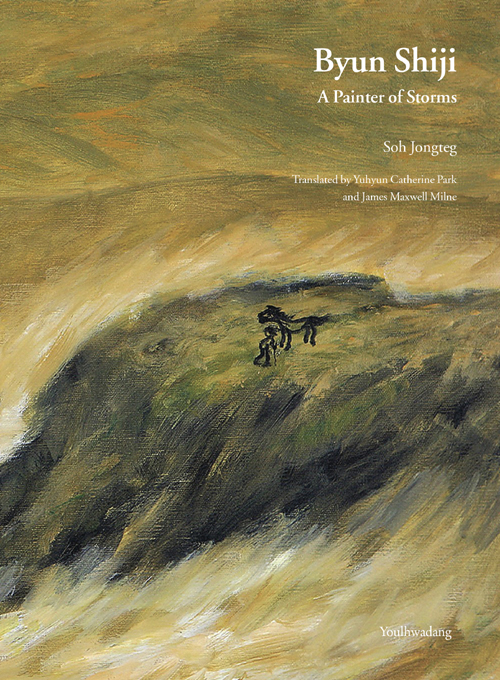
Byun Shiji [영문판] A Painter of Storms
서종택 저 | Yuhyun Catherine Park, James Maxwell Milne 역 | 열화당 | 2017년 12월





ISBN : 9788930105972 / 188쪽 220 x 140 (㎜)
이 상품에 궁금하신점이 있으세요? 1:1상담문의



아래의 도서와 구매하시면 이 도서들의 적립금을 즉시적용해 드립니다.
-

김성대
-
루이지 기리
-

-

- 26,010
- 28,800
- 54,000
- 18,000


출판사 리뷰
<변시지>의 영문판 변시지(邊時志, 1926-2013)는 제주 출생의 작가로서, 주로 제주의 바다와 바람과 말을 그렸다. 한 마리의 바닷새와 돌담의 까마귀와 쓰러져 가는 초가와 소나무 한 그루와 마침내 이 모든 것들을 휘몰아치는 바람의 소용돌이―그의 이러한 풍경 속에는 어김없이 구부정한 한 사내가 바람을 마주하고 서 있는데, 이러한 변시지 회화의 기본구도 속에는 형언할 수 없는 비애와 고독감이 고즈넉하게 녹아 있다. 화면 전체가 장판지색 혹은 건삽(乾澁)한 황토빛으로 처리되어 있고, 풍경과 인물은 먹선의 고졸(古拙)한 맛과 역동성이 함께 어울려 장대한 대자연의 율동으로 형상화한다. 제주에서 출생하여 어려서 일본으로 건너가 미술수업, 23세 때 일본의 「광풍회전(光風會展)」 최고상을 수상하여 화제를 모았던 그는 귀국하여 서라벌예대 교수를 역임하며 극사실의 비원파(秘苑派) 시절을 거쳐 마침내 제주로 돌아간다. 실로 40여 년 만의 귀향이었고, 〈폭풍의 바다〉 연작들은 자기검증의 결실이었다. 저자 서종택 교수는 이 책에서 “어설픈 서구 추수의 모더니즘 속에서 자기 예술의 정체성을 찾는 일의 어려움을 제주-오사카-동경-서울-제주로 이어지는 작가의 고향회귀의 과정이 잘 말해 준다. 변시지 예술의 구도자적 순례는 대지와 바람의 뒤섞임 속에서 마침내 황토빛으로 열렸으며 그것은 결국 그의 사상이 되었다. 그는 자연 속에서의 인간의 실존적 위상을 바라보는 우주적 연민, 달관과 체관의 어떤 높은 경지에 이르렀다. 그의 그림처럼 예술과 풍토, 지역성과 세계성, 동양과 서양이 함께 만나는 희귀하고도 소중한 사례는 아직 없다”고 결론 짓고 있다. 변시지의 그림은 얼핏 보기에 제주의 풍물이 시적으로 처리되어 있는 것처럼 보인다. 갈매기와 바닷새와 쓰러져 가는 초가, 바람 혹은 태양을 마주하고 망연히 서 있는 사내― 이 소재들은 그러나 인간 존재의 근원적 상황을 드러내기 위한 부수적인 소도구일 뿐 제주풍경을 서정적으로 그려낸 풍물시(風物詩)가 아니다. 풍경으로 처리된 변시지의 인물에서 우리가 느끼는 것은 인간에 대한 연민과 우수이고 그 표현의 저돌성은 모두 아름답고 개성적이다. 이번에 나온 영문판은, 2000년 이후 변화된 내용을 수정하고, 일부 작품을 교체하여 다시 편집한 국문 개정판을 영역한 것이다. Preface to the Revised Edition This book is a collection of writings about Byun Shiji, which are based on my encounters and conversations with him at his exhibitions and atelier, as well as at various locations on Jeju Island. It may seem a little out of the ordinary that such a book would come from an art world outsider. Nevertheless, these writings are a modest dedication to a great painter as well as a line of inquiry posed to the art community, which has been swamped by contrived Western-style modernism and stubborn traditionalism. Byun Shiji passed away in June of 2013. It happened so suddenly, and to a man whose life embodied the pilgrimage of a truly great artist, beginning with receiving the highest prize from the Kofukai Exhibition (光風?展) at the age of twenty-two, and reaching major milestones, such as his decision to return to Korea in the aftermath of the Korean War and ultimately settle down in Jeju Island. Having been displayed permanently for ten years at the Smithsonian Museum in the United States, his two paintings have recently been returned to his hometown in Korea. Plans are now underway to hold more than 500 paintings at a museum and memorial house. As I prepare the preface article, I am constantly reminded of the kindness of the great painter, who took time to explain his works to me in detail. For this second edition, I added a chronology of events and other related materials, and changed some of the photographs. I extend my appreciation to the editors at the Youlhwadang Publishers for doing a splendid job with my humble manuscript. Summer of 2017 Soh Jongteg Preface to the First Edition It was in the 1980s that I first encountered Byun Shiji’s paintings, and they made a vivid impression on me. His works seemed primordial and mythical; the result of a deep insight into the desolate nature of existence that lurks under the outward phenomena of life, characterized by an exposure to the apparent starkness of nature. At the very least, the intensity of the messages that his paintings convey to me is something that no other painters could accomplish. His paintings blend inexpressible sadness and loneliness in a peaceful manner. In a way, it may seem absurd to say that sorrow and solitude coexist in a ‘peaceful’ manner. However, images of austerity and ellipsis fill his compositions, and examples include: a seabird flying over a crooked man standing before a fishing pole under the blazing sun, appearing as if in the tilted world of a storybook illustration; and a rundown cottage, a pony facing the sea, a crow on a stone wall and a pine tree, all to be swept away by a whirlwind. He opened his world with an ocher color that blended heaven and earth, and expressed quaint, rustic beauty and energy through Oriental black-ink lines. These compositions create a primordial despair and sorrow that touch upon the roots of human existence. Just as the sweetest songs reveal the saddest thoughts, and just as the greatest dramas show the deepest struggles and defeats in tragedy, his style of revealing sadness and loneliness leads to an aesthetic pleasure that is both tranquil and peaceful. The aesthetic pleasure leads to a form of cosmic pity, which stands at the highest level of human emotion and provides an archetypal image of aesthetics in life and art. I met Byun Shiji for the first time at a small teahouse in Insa-dong, on an autumn day of 1987. He looked at me with a youthful expression, although he was already in his sixties. The elderly painter wore a beret and held a cane in his hand. He was a man with a small frame and a genial face, and spoke with the inarticulate voice of a boy. At first, I thought his long life in Japan was to blame for his inarticulateness, but he seemed far from being an astute and worldly person. Then, at one point, he began to walk in a slantwise fashion and I reached out to support him. He lifted his cane and pointed at the bar in front of us. He smiled like a naughty boy, and I got blind drunk that night. How does the wind and earth of a place influence the artists who grow up there? What was the meaning of Spain’s Catalonia to Pablo Picasso and Joan Miro? What about Mediterranean humidity and heliotropic plants to Albert Camus? What is the meaning of earth and wind to Jeju’s Byun Shiji? The southern scenery of Jeju Island in Byun Shiji’s paintings was something more than love for his native place or a lyrical ode to nature. He found his method and developed his philosophy from the lines, lights, and forms of Jeju. He seemed to undertake a journey into solitude and find mythic narratives within these lines, lights, and forms of Jeju. The sun, sea, winds, seagulls, storms, crows, and ponies were borrowed as motifs for an exploration of existence, rather than as mere objects of a landscape. Being deemed a painter of the provincial or of landscape poetics was not his creative raison d’etre. He constantly modified, deleted, and added such motifs to represent the existential situation. His artistic pilgrimage, from Jeju to Osaka, then to Tokyo and Seoul, and finally back to Jeju, finally culminated in the discovery of an ocher color, which embodied the prima materia of his thoughts. I met Byun Shiji many times. The first time I met him was by appointment at a teahouse in Insa-dong. I also walked into his atelier in Seogwipo City without notice. I must admit that I came to write this book from a place of ignorance, which reveals a sort of reckless bravado in my case. As an aspiring painter-turned-professor who teaches literature, I find a sense of loss for painting hidden in my curriculum vitae. I used to wander around the streets of Insa-dong after becoming tired of the monotony of daily life, or when feeling hollow inside. I would often walk along the long corridor of the exhibition hall of the Gwacheon National Museum of Modern and Contemporary Art, and turn away from it only after purchasing a fine art print. Whenever a painting on display reminded me of the language of my dreams, I shivered. What I like is one thing, what I know is another. Moreover, the method and level of critique can be an issue when one attempts to say something about an artist. Still, Byun Shiji’s paintings inspired me to ignore all of this. More than anything, I am afraid that this book may unintentionally add another layer of color over his artwork. To help the readers better understand his works, I included Byun Shiji’s own writing, Art and Climate: Artist Notes on Lines, Colors, and Forms (Seoul: Youlhwadang Publishers, 1988) in the new publication. I also made small corrections to Korean expressions that were used inappropriately, a problem associated with his long-term stay in Japan. I would like to thank CEO Yi Ki-ung of Youlhwadang Publishers for approving the publication of this book. I also want to thank Won Yong-deok and Yoon Se-young for kindly providing me with information and guidance. On an early spring day of 2000, Soh Jongteg




Preface to the Reviced Edition 5
Preface to the First Edition 7
A Little Boy on Pony Back 13
Days of the Third Parthenon 19
The Kofukai Tornado 89
In Search for the Archetype of Korean Beauty 45
His Thoughts on Earthiness 59
Sea of the Storm 87
Notes 127
Art and Climate Byun Shiji 131
Chronology of Events 175

