



스크랩

구간

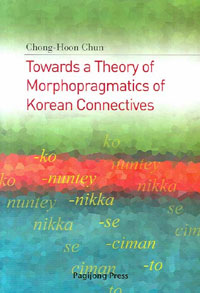
TOWARDS A THEORY OF MORPHOPRAGMATICS OF KOREAN CON

원제 : 한국어 연결어미의 형태- 화용론 이론을 향하여

CHONG-HOON CHUN 저 | PAGIJONG PRESS | 2007년 12월
북트리

정가
$40.00
판매가
$22.00 (45%↓) 최저가 보상
적립금
$0.44 (2%P)
출고예상일
2026년 10월 09일 수령예상일 안내
북카트 담기 바로구매하기 위시리스트담기

평점 -  ·  리뷰 0

리뷰 쓰기

ISBN : 9788978789608 / 309쪽 158 x 230 (㎜)

이 상품에 궁금하신점이 있으세요? 1:1상담문의

추천inside
Adobe Flash Player 가져오기

이 분야의 베스트셀러

아래의 도서와 구매하시면 이 도서들의 적립금을 즉시적용해 드립니다.

  • 22,500
  • 18,000
  • 19,800
  • 15,210

책 소개

출판사 리뷰

저자 소개

한양대학교 졸업
동국대학교 일어일문학과 석사
일본 Tohoku University 국제문화연구과 석사
호주 The University of New South Wales 언어학 박사
FreeMATE 영어교재개발연구소 소장
코리아타임스 영어교육용 별지 NIE Times “그림으로 이해하는 전종훈의 영어교실” 원고 기고(www.ktimes.co.kr)
신안산대학교 실용 영어 작문 강의
현재 전종훈 번역연구소 소장(www.chuntrans.com)


저서
- 『그림으로 연상하는 영어 표현 1(Imagine English Expressions 1)』, 전종훈 번역연구소, 2014.
- 『그림으로 영어 쉽게 쓰기(Easy and Practical English Writing)』, 전종훈 번역연구소, 2014.
- 『형상화로 영어 쉽게 쓰기(Practical English Writing)』, 박이정, 2013.
- 『Towards a Theory of Morphopragmatics of Korean Connectives(한국어 연결어미의 형태-화용론 이론을 향하여)』, 박이정, 2008.


역서
- 『Korean Culture for Curious New Comers(통으로 읽는 한국 문화)』, 박이정, 2013.
- 「재진입(Re-entry)」(『depaysement(더페이즈망)』 중), 아르코미술관, 2011.


논문
- 「연결 어미와 화용론」, 제25차 한국어의미학회 전국학술발표대회 발표집, 28-34쪽.
-  Nŭnte as a Sentence-Final Suffix in Korean: a Relevance Theory Approach, Proceedings of the Fourth KSAA Biennial Conference: Intellectual Engagements with Korea: 146-54.
-  A contrastive linguistic study of Korean and Japanese adverbial clause based on Minami’s (1974) hierarchical structural model, Proceedings of The Sixth Annual Meeting of The Association for Natural Language Processing: 284-87.

목차

목차
Foreword
Thesis Absract
Thesis Acknowledgements
List of Figures
List of Tables
List of Symbols
List of Abbreviations
Yale Romanisation System
1. Introduction
2. Four Pragmatic Theories
3. Theoretical Framework
4. The Data
5. Propositional Relations
6. The Use of Korean Conjunctive Verbal Suffixes
7. The Nature of the Meanings of Korean Conjunctive Verbal Suffixes : Conceptual and Procedural Meanings, and the Scale of Default-Semantic Meanings
8. Conclusion

top