









출고예상일 안내
주문하신 상품이 한국에서 현지 배송을 위한 출고단계가 이루어질 것으로 예상되는 날짜입니다. 상품을 준비하는 과정에서 내부적인 사정으로 인해 출고예상일에 다소 오차가 생길 수 있습니다.
여러 상품(예약상품포함)을 함께 주문하신 경우 출고예상일이 가장 늦은 날짜에 맞춰 함께 배송됩니다.


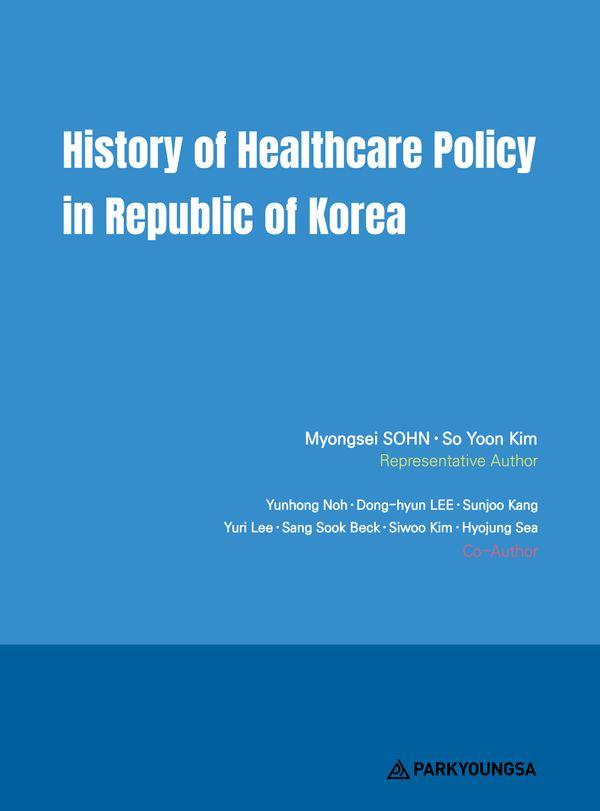





ISBN : 9791130317700 / 216쪽 / 410g / 188 x 257 (㎜)
이 상품에 궁금하신점이 있으세요? 1:1상담문의



아래의 도서와 구매하시면 이 도서들의 적립금을 즉시적용해 드립니다.
-
조성호
-
마창석
-
김태유
-

홍지수, 홍은지
- 29,700
- 22,500
- 16,200
- 30,000


출판사 리뷰
Preface We are very delighted that the book “History of Healthcare Policy in Republic of Korea” is going to be published. This book provides information on the history and development process of Korea’s healthcare policy and the transformation process of the healthcare system. The vast amount of research data collected in this book is believed to be a major foundation for the development of the healthcare system and conducting research on policies in the future. In addition, We believe that this book can be an important resource tool for establishing healthcare projects and policies in developing countries. The 2019 World Health Assembly adopted an ambitious resolution recognizing the role of healthcare system and policy in providing the full range of health services needed throughout the life course, including prevention, treatment, rehabilitation, and palliative care. Achieving the health?related SDGs, including UHC, will not be possible without a stronger healthcare system and policy. The current healthcare system in Korea is the product of continuous development over the history of 80 years. Although the system is not in the ultimate, finalized state but still in the process of improvement in all dimensions, the Korean healthcare system has achieved a high level of development compared to that of advanced countries in terms of the health of national population or industrialization. However, this high level of healthcare system is not something that has been achieved by an overnight miracle or by simple adoption of other countries’ systems. The healthcare system as an institution is a historical product of continuous development in which all related parties in healthcare ? health professionals, those responsible for drafting and enforcement of health policy, and the general public ? are involved in shaping and changing the system to suit specific situations of Korea in the midst of turbulent changes that the society has experienced since the enlightenment period of the country. In this context, there is no doubt that the domestic healthcare system is currently in a highly mature stage, but it is also evident that there are still a range of problems that need to be addressed and resolved. In order to identify these problems, it is necessary to examine and study the historical background from an objective standpoint, draw implications for today’s healthcare system in Korea, and come up with rational solutions for real-world problems based on the lessons learned from the history. This will serve as a sensible and articulate basis for establishing the future direction and targets of the healthcare system in Korea. In this book, the records from 1959 to 2020 related to governmental projects, policies, and institutions held by the government or healthcare-related organizations that are judged to have value in health history are investigated and objective accounts on the records and data are described. Thus, the healthcare policy and system have been described as “actions and products that are performed or produced for adequate combination of the state intervention and the principles of market economy for fair distribution of health and medical resources under the principle of equity and efficiency with a view to promoting public health and satisfying the demand for treatment of diseases”. Based on the definition and general perception, the content of this book is divided into three categories as follows. First, the overall public healthcare system in Korea has been reviewed. Second, in terms of healthcare policies implemented under this system, data and materials on health insurance, separation of dispensary from medical practice and healthcare industry have been reviewed. Third, data and materials on management of infectious disease in terms of prevention and disease management have been reviewed. However, all policies, projects, and institutions were not planned or implemented as a single, isolated policy or project, and all of these were executed or implemented in an organic and interdependent relationship. Therefore, Chapters 2 and 3 provide detailed information on the respective aspect, but in order to understand the relationship between these contents in a broader framework, it would be helpful to look into the overall historical flow from the viewpoint of healthcare policy considering the time of the milestone events in understanding the changes in healthcare system in Korea. In this context, this book provides an account on various projects, policies and institutions related to healthcare system of Korea in light of the change of the times with historical perspectives. In order to share these valuable experiences and cases of healthcare policy in the international community, we are publishing an English of healthcare policy history. This work is part of the Health and Medical Education Competency Enhancement Project of the University of Health & Allied Science (UHAS) in Ghana, which is facilitated by the Ministry of Education and supported by the National Research Foundation (NRF) of Korea. The goal of this project is to make the UHAS experience a new leap forward as a health-specialized higher education institution in Ghana while strengthening the capabilities of community health education at UHAS’s medical school, nursing school, and health school. The aim is to help UHAS cultivate differentiated healthcare professionals in the health sector who can then help improve the health standards in Ghana and other countries in Africa. Therefore, we are preparing to provide a practical reference textbook that can provide information on building, changing, and implementing healthcare’s strategies so that professors and students can appropriately apply them in the field of healthcare in each stage of economic growth. Further, we hope that this book will help establish realistic, affordable, and effective healthcare delivery systems and policy that are tailored to the economic and cultural level of each developing communities that still lack access to essential services for healthcare policy. We sincerely appreciate the co?authors, editorial board members, researchers for helping us with this tedious and continuous work. We would like to thank to Dr. Yunhong Noh, Prof. Dong?hyun LEE, Prof. Sunjoo Kang, Prof. Yuri Lee, Prof. Sangsook Beck, and Dr. Siwoo Kim and the researchers, Ms. Hyojung Sea(saina), Ms. Dasol Jessica Ro and Ms. Jiwon Park for their invaluable assistance in participating in the project and helping write and edit this book. We also appreciate professional proofreading given by Editage. Lastly, we would like to express our gratitude to the researchers who made efforts to publish this book while participating in the project, as well as the National Research Foundation of Korea(NRF) who supported the production of this book. We would also like to thank Parkyoung Publishing & Company for their guidance throughout this publishing process. Dr. Myongsei SOHN Chairman, RIGHT Fund Former President, HIRA Emeritus Professor, Yonsei University Prof. So Yoon Kim Yonsei University College of Medicine Director, Asian Institute for Bioethics and Health Law

-
- 저자 : MYONGSEI SOHN 외공저

Preface ⅲ
Chapter 1.
Overview of History of Healthcare Policy in Korea
Section 1. Before 1945; Historical Background of Healthcare Policy\t3
Section 2. From 1945 to 1960s; Birth of Healthcare Policy\t9
Section 3. From 1970s to 1980s; Expanding Healthcare Policies\t13
Section 4. From 1990s to 2000s; Ongoing Efforts to Improve theQuality of Life for the Public\t19
Chapter 2.
Changes in policies for providing medical services in Korea
Section 1. Establishment of Public Health System\t29
Section 2. Current Status and Future Development of HealthcareResources\t35
Section 3. Changes in Health Care Organizations and the Present\t45
Section 4. Aspects of the Development of Changes in the HealthInsurance System\t57
Section 5. Changes in Drugs and the Pharmaceutical Industry\t65
Section 6. Changes in Health Promotion Policies\t81
Section 7. Promotion of Maternal and Child Health andImplementation of Family Planning\t89
Section 8. Changes in Policies for Disease Control and Eradication\t101
Chapter 3.
Discussion of major issues with respect to changes in healthcare policy
Section 1. Beginning of the Debate on Bioethics and Safetyand the Transition Process\t115
Section 2. Discussion on the institution of induced abortion\t125
Section 3. Attempts to Introduce For-Profit Medical Corporations\t135
Section 4. Conflicts of Various Issues Following Separation ofPrescribing and Dispending\t147
Section 5. Traditional Korean Medicine Policy and Conflict betweenTraditional Korean Medicine Doctors and Pharmacists\t161
Section 6. Response to New Infectious Diseases and PublicHealth Crisis\t173
Reference 193
Table
〈Table 1〉 Annual Trends of Public Health Centers and CommunityHealth Posts 30
〈Table 2〉 Maternal and child health projects by life cycle 98
〈Table 3〉 Main areas of debate on inclusion in the Bioethics Act 118
〈Table 4〉 Types of medical corporation 138
〈Table 5〉 Comparison between for-profit and nonprofit medicalcorporations 139
Figure
〈Figure 1〉 Health Care System from Medical Insurance Act 16
〈Figure 2〉 Development objectives of Korea’s health industryin stages 21
〈Figure 3〉 Number of outpatients visits per capita (2018) 22
〈Figure 4〉 Public Health Delivery System 31
〈Figure 5〉 Medical insurance system (July 1977-November 1998) 60
〈Figure 6〉 The first Western-style hospital, Jejungwon 66

