









출고예상일 안내
주문하신 상품이 한국에서 현지 배송을 위한 출고단계가 이루어질 것으로 예상되는 날짜입니다. 상품을 준비하는 과정에서 내부적인 사정으로 인해 출고예상일에 다소 오차가 생길 수 있습니다.
여러 상품(예약상품포함)을 함께 주문하신 경우 출고예상일이 가장 늦은 날짜에 맞춰 함께 배송됩니다.


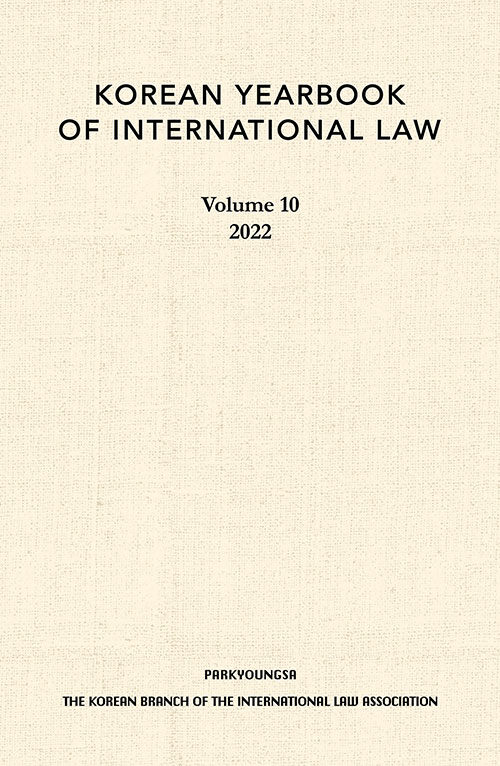





ISBN : 9791130345420 / 464쪽 / 882g / 176 x 248 (㎜)
이 상품에 궁금하신점이 있으세요? 1:1상담문의



아래의 도서와 구매하시면 이 도서들의 적립금을 즉시적용해 드립니다.
-
구오제드, 송이핑, 조신
-
김태유
-
조성호
-

권석만
- 26,100
- 16,200
- 29,700
- 26,100


출판사 리뷰
The Korean Yearbook of International Law has reached its tenth volume, and as will sometimes happen over the course of a decade, we have suffered a loss within our community. Professor Choi Seung-Hwan of Kyunghee University Law School, the first President of the Korean branch of the International Law Association, passed away suddenly while this volume was being prepared. A driving force behind the publication of the Yearbooks, he is and will be much missed. For more, please refer to the Editorial Board’s moving tribute to Professor Choi in the beginning of this volume. As we carry on with Professor Choi’s vision to continue and improve the yearbook as a reference abroad for Korea’s international legal practice, the current volume has come together under a broad theme of risk to international exchange. Navigation, trade, business, and immigration across borders create bounties of opportunity. At the same time, these interactions and interfaces are also sources of legal, health, environmental, and other risks. International law, both public and private, is a major means of managing and mitigating the risks that arise out of international exchange and cross-border issues. The current collection of articles and reports delve into this role of international law in a variety of contexts and circumstances. The article Legal Status of Marine Scientific Research in the Law of the Sea by Professor Lee Chang-Wee examines the Law of the Sea rules applicable to marine scientific research and the conflicts over these rules, most prominently between China and the United States, for a dynamic view of these much-contested rules. Marine research is a leading example of an activity rife with both opportunities (scientific and economic) and risk (security and military), and state behaviors surrounding the international law in this area demonstrate the high stakes of deciding how international law will manage the risks. The Meaning of “Service” as One of the Requirements for Recognition and Enforcement of Foreign Judgments by Judge Kim Young-Seok looks at service of process in international litigation. Litigation across borders, along with the recognition and enforcement thereof, is a vital means of managing cross-border risks, while service of process allows individuals to be notified of and respond to the legal risk that such litigation raises in turn. Judge Kim gives a thoughtful and nuanced exploration of a landmark decision by the Korean Supreme Court in this field, in the process making the crucial distinction between legality of the service of process itself under domestic law (Korean law, in this case) and its being a requirement for recognition and enforcement. Judge You Jung Hwa’s article, Private International Law Issues in Joint Venture Agreements and Shareholders’ Agreements Governed by Korean Law, takes a look at the sometimes tangled issues that arise in the interface between different jurisdictions, and proposes several strategies for the advance separation of contract and corporate legal aspects to manage disputes that may arise out of joint venture agreements. Attorney Han Mino’s article, Revisiting Optional Arbitration Clauses Before the Korean Courts, critiques a major Korean Supreme Court judgment that deemed optional arbitration clauses ineffective unless both parties consent. Attorney Han then goes on to argue that courts should take a more pro-arbitration stance to resolve practical confu- sion over the validity of these clauses. Expanding the effectiveness of optional arbitration clauses would certainly change the calculus of dispute and legal risk management, and it remains to be seen if the Korean courts will listen to these calls. Dr. Chung Min Jung opens the Special Reports section with a breakdown of the Constitutional Court’s 2020 decision on renuncia- tion of nationality by Koreans who hold multiple nationalities. The balance between individual rights and the need for a large, ready military force through mandatory military service has always been a delicate one in Korea, yet the thorough treatment by the Special Report shows that individual rights and practicality are not necessarily in tension: The Constitutional Court’s reasoning is clear that disallowing the relinquishment of Korean nationality after the nationality selection period not only causes undue hardship for the multiple nationality holders, but is also impractical for military purposes. The subject of Professor Lee Jang-Hie’s report, the Inter-Korean Basic Agreement of 1991, may be characterized as a major push by the two Koreas to manage and mitigate perhaps the single greatest geopolitical risk on the Korean peninsula and the surrounding region: that of military tension and, at the extreme, another Korean War. By examining both the substance of the Agreement in its usefulness to building a framework for Korean peace, and its form which Professor Lee argues meets the requirements of a binding international treaty, the conclusion is reached that the Agreement should be implemented by both Korean governments and leveraged as a foundation for lasting peace. Professor Lee Gyooho’s special report on industrial security laws in the Republic of Korea outlines the state of the law on industrial security and argues for greater coordination with Japanese law, as South Korea and Japan are two of the states most affected by security concerns in their high-tech industries. This may be an emerging area of cooperation and coordination to manage security risks in these industries. In a special report on the normalization of Korea-Japan relations in the Yoon Suk-Yeol administration, Professor Hong Sungkee makes comparisons between the Korea-Japan relations policies of the current administration an past ones, and argues for a productive way forward for the two countries beyond historical gridlock based on the foundational legal principle that a contract must be honored. Dr. Doh See-Hwan, a recurring and valued contributor to the Yearbooks, contributed a special report on the invasion of Dokdo and the Korea-Japan treaty in 1905 through the lens of the San Francisco Peace Treaty in 1951. Dr. Doh argues that Korea’s sovereignty over Dokdo and the illegality of Japan’s annexation of Korea are confirmed by the San Francisco Peace Treaty, making a firm grounding in international law a vital part of East Asian peace and justice going forward. In the Recent Development section, Professor Lee Seok-Yong comments on military activities in other states’ exclusive economic zones (EEZs), which is all the more interesting read together with Professor Lee Chang-Wee’s article on the legal aspect of marine scientific research. Military activities in EEZs are reasonably viewed as another front in the struggle between states over the law of the sea, which is not an abstract academic argument but often a matter of security and even survival. Dr. Chung Min Jung reported on the Korean National Assembly’s international law resolutions taken in 2022 and added insights such as the decrease in the quantity of international law resolutions undertaken by this body, including human rights resolutions. The five international law resolutions by the Assembly in 2022 mainly concerned geopolitical issues, marking a departure from prior years when human rights resolutions were more dominant. Professor Won Jae-Chun provided a timely report on the international investor arbitration tribunal ICSID’s decision in Lone Star Holdings vs. Republic of Korea, pointing out where the decision fell short and presenting directions the Korean government could seek in the rectification proceedings. Investor claims like the Lone Star Holdings case represent a major risk for states in their government policy and enforcement actions, and these experiences along with commentary on them will prove valuable going forward. In Contemporary Practice and Judicial Decisions, Judge Hong Eungi presents judicial decisions in public international law, including the arrest of foreign nationals and their right to be notified of the right to have the consuls of their country of nationality notified; the legality of a deportation order of a refugee that does not specify the country of repatriation; and the recognition of gender change for transgender people with minor children. This final section is rounded out by translations of the Quarantine Act, Framework Act on Carbon Neutrality and Green Growth, and Space Development Promotion Act, together with Judge Jang Jiyong’s summary of judicial decisions in public international law including the applicability of the CISG, assumption of obligations, formation of marriage, and recognition of a threefold damage awarded by a foreign court. The depth and breadth of the articles and reports in this volume come together to form a picture of Korean international legal practice in 2022 of responding to new and known risks at all levels, through the international legal process, legislation, litigation, diplomacy, judgments, resolutions, and more. This is a truly dynamic and multilayered process that no one book can hope to capture the entirety of, but the Korean Yearbook of International Law delivers at least one slice of this organic, pulsing process for a year. Though I may not agree with all the selections and some of them have contrasting viewpoints, perhaps this, too, is a reflection of the contradictions and strife inherent in the course of international law. This volume also marks the end of the tenure of the current editorial team led by Professor Lee Gyooho, including myself as the Executive Editor. Professor Lee and the team, including the tireless Ms. Choi Ji-in as the staff editor, deserve all accolades for their energetic dedication and unending patience. For myself, it has been a privilege working with the scholarly output of so many talented scholars and practitioners. I wish the succeeding team every success in continuing this important work. LEE Jee-Hyung Executive Editor Korean Yearbook of International Law

-
- 저자 : 세계국제법협회 한국본부

EDITORIAL NOTE
LEE Jee-Hyung
ARTICLES
LEE Chang-Wee
Legal Status of Marine Scientific Research in the Law of the Sea: Conflicts over Codification and Policy-Oriented Jurisprudence as a Solution
KIM Young-Seok
The Meaning of “Service” as One of the Requirements for Recognition and Enforcement of Foreign Judgments -Focusing on the Supreme Court of Korea 2017-Da-257746 Judgment-
YOU Jung Hwa
Private International Law Issues in Joint Venture Agreements and Shareholders' Agreements Governed by Korean Law
HAN Mino, YOO Eun Kyung (Jennifer)
Revisiting Optional Arbitration Clauses Before the Korean Courts
SPECIAL REPORTS
CHUNG Min Jung
The Constitutional Court's Decision and Recent Legislation Related to Relief for Elapsing the Period of Renunciation of Nationality by Multiple Nationality Holders
LEE Jang-Hie
The Inter-Korea Basic Agreement of 1991 - Its legal nature and its role in the promotion of peace on the Korean Peninsula
LEE Gyooho
Industrial Security Laws in the Republic of Law: Comparison with their Japanese Counterparts
HONG Sungkee
Normalization of Korea-Japan Relations in the Yoon Suk-Yeol Administration: The Comfort Women Agreement and Judicial Decisions on Compensation for Forced Labor
DOH See-Hwan
International Legal Review of the Invasion of Dokdo and the Korea-Japan Treaty in 1905 resumed by the San Francisco Peace Treaty in 1951
RECENT DEVELOPMENTS
LEE Seok-Yong
Military Activities in Other States’ Exclusive Economic Zones
CHUNG Min Jung
Resolutions Relating to International Law Adopted by the 21st National Assembly in 2022
WON Jae-Chun
ICSID Arbitration Tribunal Award on Lone Star Holdings v. Republic of Korea and Its ISDS Implications
CONTEMPORARY PRACTICE AND JUDICIAL DECISIONS
HONG Eungi
Judicial Decisions in Public International Law (2022)
LEE Jee-Hyung·PARK Hyeon-Seok
QUARANTINE ACT
LEE Jee-Hyung·PARK Hyeon-Seok
FRAMEWORK ACT ON CARBON NEUTRALITY AND GREEN GROWTH FOR COPING WITH CLIMATE CRISIS
LEE Jee-Hyung·PARK Hyeon-Seok
SPACE DEVELOPMENT PROMOTION ACT
JANG Jiyong
Judicial Decisions in Private International Law (2022)
Treaties/Agreements Concluded by the Republic of Korea
INDEX
AUTHOR GUIDELINES AND STYLE SHEET

